Are There Crocs At Fitzroy Island?
No Fitzroy-specific crocodile warnings exist. Here is what Queensland Parks, GBRMPA and the ferry operators actually say about crocodiles, snakes and swimming safely at Fitzroy Island.
Are There Crocs At Fitzroy Island?
No. Queensland Parks, GBRMPA and island operators list no crocodile warning, sighting report or closure for Fitzroy Island, which sits 25 km east of Cairns in open Coral Sea water. Estuarine crocodiles in this region are river and estuary animals, and the island has neither. General tropical North Queensland caution still applies, as it does anywhere along this coast.
That is the whole answer in one paragraph, but the worry behind the question deserves a proper treatment, because "crocodile country" is a fair description of far north Queensland and an unfair description of a continental island 45 minutes offshore by fast catamaran. Every ferry that makes the crossing, from the Fitzroy Island Adventures full day to the Sunlover catamarans and the Fitzroy Flyer, departs from a Cairns marina that sits much closer to crocodile habitat than the island ever will. The irony of the croc question is that the mainland terminal is the riskier address, and even there the risk is managed, signposted and small.
Why the difference? Estuarine crocodiles favour warm, muddy, brackish water: river mouths, mangrove creeks, tidal estuaries and calm inshore channels where they can hunt in murky conditions. Fitzroy Island is a granite national park rising straight out of clear ocean water, surrounded by fringing reef and swept by currents. Queensland Parks describes the island's setting as granite outcrops, open woodlands, rainforest, mangroves and coral beaches, but the mangrove stands are small and there is no estuary, no river mouth and no tidal creek system of the kind crocodiles use as territory. There is also no land-based food chain that suits a large apex predator.
What the official record shows matters more than anecdote. The Queensland Parks page for Fitzroy Island carried no park alerts at the most recent check, and no crocodile-specific alert for the island appears anywhere in the sources reviewed for this article. The Queensland Government's wildlife bulletins and the marine park authority's notices name rivers, swimming holes and mainland beaches when crocodiles are involved. Fitzroy Island does not appear in that ledger. No saltwater crocodile warning has been issued for Fitzroy Island, though the usual caution for tropical North Queensland waters still applies. None of this means the ocean around Cairns is a swimming pool. It means the hazards are different from the ones people imagine, and the rest of this article takes those real hazards seriously: stingers, currents, and the honest limits of what any operator can promise about wild animals. The practical payoff of being reassured about crocs is that a nervous traveller can stop worrying about the wrong thing and start planning the right trip, whether that is the cheapest half-day ferry at from A$88 per person or the guided snorkel safari at from A$168.
Where Do Crocodiles Actually Live Around Cairns?
Around Cairns, estuarine crocodiles live in the river systems, estuaries and mangrove creeks of the mainland: the Barron River, Trinity Inlet and the stretches of coast north and south of the city. Queensland's own advice is to assume any water body in crocodile country may hold a crocodile and to swim only where signs, nets and lifeguards say you can. None of that habitat exists on Fitzroy Island.
The distinction is habitat, not distance. Cairns is built on a coastal plain laced with exactly the water crocodiles want. The city's marinas sit at the mouth of Trinity Inlet, a mangrove-lined estuary, and the Barron River delta lies just north of the airport. Those are genuinely crocodile-managed waters, and Queensland's environment department posts crocodile sighting signs and management zone notices along them. A traveller standing at the Reef Fleet Terminal waiting for the Sunlover boat is closer, in straight ecological terms, to crocodile habitat than they will be at any point during the day on Fitzroy Island.
The island breaks the pattern completely. Twenty-five kilometres of open water separate it from those estuaries, and while crocodiles can swim long distances in theory, the Coral Sea current between Cairns and the island is cold, rough and pointless for an animal that hunts by ambush in still, murky water. There is no record in any source reviewed here of a crocodile establishing itself on Fitzroy Island. A day trip on the Fitzroy Island Adventures catamaran, the most reviewed product serving the island at 4.5 from 1,990 reviews, crosses water that has never carried a croc advisory.
| Factor | Mainland estuaries near Cairns | Fitzroy Island |
|---|---|---|
| Water type | Brackish, murky, tidal | Clear open ocean |
| Crocodile habitat suitability | High: mangroves, creeks, river mouths | Low: granite shoreline, no estuary |
| Official crocodile warnings | Issued for named rivers and beaches | None found in any source |
| Swimming guidance | Only at patrolled, signposted locations | Welcome Bay and Nudey Beach are the named snorkel zones |
The honest caveat is the one Queensland officials repeat for the whole region: crocodiles are wild animals, individual movements cannot be ruled out absolutely anywhere on this coast, and the correct posture is informed caution rather than either fear or complacency. If you ever see a crocodile anywhere in Queensland, report it. The state's wildlife officers track every report, and it is that reporting system that keeps the island's clean record verifiable rather than assumed. General tropical caution means: read the signs at any mainland swimming spot, never feed wildlife, never dangle limbs from boats, and take the serious hazards, which on Fitzroy Island are marine stingers and currents, at their actual weight.
Are There Snakes On Fitzroy Island?
Yes, snakes almost certainly live on Fitzroy Island, because it is a rainforest-covered national park and snakes live in every such park in the Wet Tropics. No species list, bite record or snake-specific warning for the island exists in the sources reviewed. Queensland Parks' advice for the island's four walking tracks is ordinary park advice: stay on the track, and check the park alerts page before you walk.
This is where honest reporting has to resist the urge to comfort. A reader asking about crocs is often really asking "is anything on this island going to hurt me", and the truthful answer includes snakes, because a 2 km stretch of national park rainforest without snakes would be the biological anomaly, not the danger. What can be said firmly is that nothing in the official record singles Fitzroy Island out. There is no snake alert, no incident history and no species inventory in any material reviewed for this article. The island's wildlife story, as Queensland Parks tells it, is dominated by birds: pied imperial-pigeons that migrate in to nest in the summer fruiting season, buff-breasted paradise-kingfishers that arrive early in November, orange-footed scrubfowls, sulphur-crested cockatoos and emerald doves.
The practical guidance is short. Wear closed shoes on the Lighthouse Road and Summit tracks, both graded difficult by Queensland Parks, partly for the terrain and partly because a sun-warmed stone path in October is exactly where a python would be. Snakes in Australian parks are far more afraid of you than the reverse, and bites on walking tracks are vanishingly rare. Do not poke hands into rock crevices, do not try to photograph a snake from close range, and give any snake you do meet the metre or two of respect it wants.
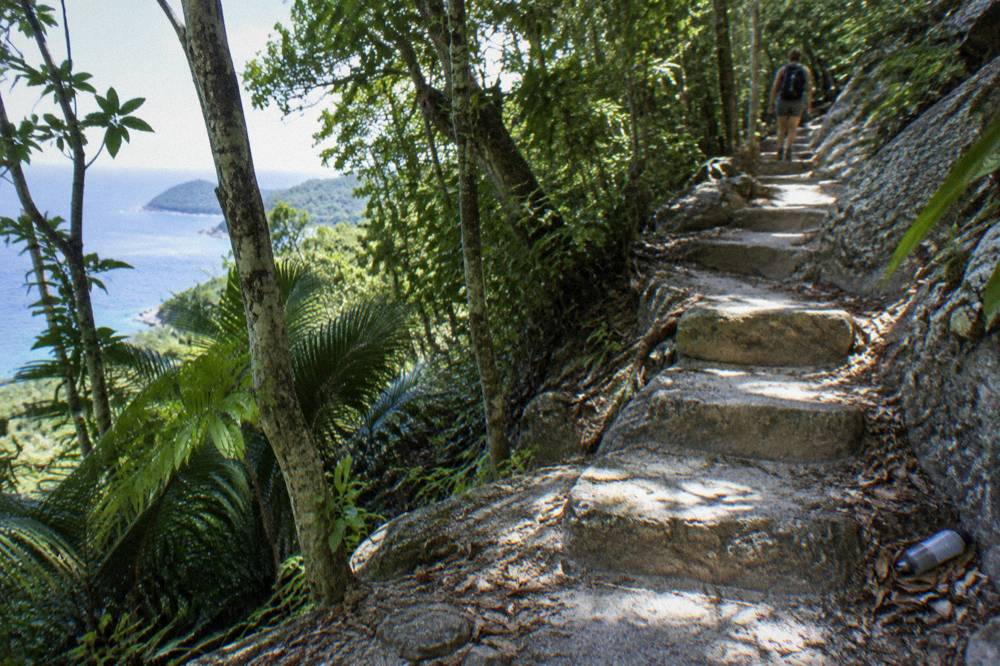
The four walks themselves are all in the national park section of the island, and Queensland Parks keeps them honest: the Secret Garden track at 700 m return is a 25-minute moderate loop, the Nudey Beach track is 1.2 km return and moderate, while Lighthouse Road at 3.6 km return and the Summit track at 4 km return are both difficult and demand real effort. A full write-up of all four, including what each one actually looks like underfoot, is in the Fitzroy Island walks and lighthouse trail guide. The park's official things-to-do page is the source to check for track conditions before you go, since tracks have closed temporarily in the past for weather damage and planned burns.
For travellers whose wildlife nerves are really about the water, the walk from the jetty to Nudey Beach is on a predominantly bitumen path with stone steps, not a jungle expedition, and the snorkelling zones at Welcome Bay and Nudey Beach are open, visible and busy with other swimmers for most of the day. The crowds themselves are the reassurance: hundreds of people snorkel these two bays every day on the standard day trips, and the pattern of decades of that traffic is the best safety data the island has.
Is It Safe To Swim At Fitzroy Island?
Swimming at Fitzroy Island is considered safe within the two zones Queensland Parks names, Welcome Bay and off Nudey Beach, with the standing tropical caveat: a stinger suit is advised November to May, with higher risk from October. The park service warns that snorkelling elsewhere around the island may be dangerous due to strong currents. Whether any swimming enclosure exists at Welcome Bay is not verified, so do not plan on one.
This is the section that matters, because the crocodile question is usually a proxy for the swimmer's question, and the genuine hazards on Fitzroy Island are the ones the official sources actually name. Queensland Parks is specific: the fringing reef of Welcome Bay and Nudey Beach is the sanctioned snorkelling, and other locations around the island may be dangerous because of strong currents. That wording, "may be dangerous", is the park service declining to promise calm water at every headland, and swimmers should take it exactly as written. Stay in the bays where the boats anchor and the people gather.
Stingers are the real seasonal issue. The resort's own FAQ states that box jellyfish and Irukandji "might be present year-round, but there is a higher risk between October and May", that stinger suits should be worn when swimming or snorkelling and are available to hire, and that vinegar stations stand around the resort. That is the same guidance reef operators across the region follow. The stinger season and swimming guide covers the full season picture, and the deeper question of whether Fitzroy Island is safe to swim at all is handled there too.
| Hazard | Status on Fitzroy Island | What the official or operator guidance says |
|---|---|---|
| Crocodiles | No warning ever issued for the island | General North Queensland caution only |
| Snakes | Present as in any rainforest park, no specific alert | Stay on tracks, check park alerts |
| Marine stingers | Real seasonal risk, November to May, higher from October | Stinger suit advised; suits available to hire; vinegar stations at the resort |
| Strong currents | Named risk outside the two main bays | Snorkel Welcome Bay and Nudey Beach only |
| Netted swimming enclosure | Not verified either way | Do not assume an enclosure exists |
The tours bake this into their gear. The Fitzroy Island Adventures full day lists optional snorkel gear and stinger suit selections at booking, the Sunlover options let you add snorkel equipment or a glass-bottom boat, and the guided snorkel safari includes snorkel hire for the whole day until 4:00 pm. If a traveller wants to see the reef without entering the water at all, the glass-bottom boat at 45 minutes a trip is the dry option, and the two-island and Moore Reef combos all include one. None of these operators promises a turtle, a ray or a fish, and this article will not either: wild animals are wild, a quiet day is possible, and the honest tour descriptions say "opportunities" rather than guarantees.
What Do The Official Sources Actually Say?
Queensland Parks tells Fitzroy Island visitors to stay on tracks, take no campfires, and check the park alerts page before walking; GBRMPA sets the wildlife rules for the surrounding marine park, which prohibit touching, chasing or feeding any animal. Neither agency has ever issued a crocodile notice for the island. The island and its waters sit inside the Great Barrier Reef World Heritage Area and two marine parks.
It is worth quoting the structure, because official caution is often misread as official alarm. The Queensland Parks safety page for Fitzroy Island covers the ordinary business of a national park visit: stay on the walking tracks, no campfires anywhere in the park, and check gear for soil, seeds and insects before arriving, because the World Heritage islands are kept among the most pest-free in the world and visitors are part of that defence. Crocodiles do not feature. The park's visiting-safely page is the live source for any future alert, and a two-minute check there before travel is the responsible habit the rangers themselves recommend.
Out on the water, the rules belong to the marine park authority. GBRMPA's responsible reef practices cover how to behave around turtles, fish and every other animal: no touching, no leaning on, no pursuing, no feeding, and slow, neutral boat handling near surfacing wildlife. These rules exist to protect animals from people far more than people from animals, and a snorkeller who follows them is behaving exactly as the marine park intends. The fringing reef at Welcome Bay is a coral garden in a World Heritage Area, not a hazard zone, and the strongest advice attached to it is about not standing on the coral.
There is one more honest note for the anxious reader, and it is about confidence calibration. The absence of a crocodile warning is strong evidence but it is not a mathematical guarantee, because no official agency certifies any wild place as crocodile-free, and this article will not invent that certificate. What can be said is that the evidence runs entirely one way: no warning, no sighting record, no suitable habitat, no history in decades of heavy tourist traffic. Every day-trip product serving the island, from the cheapest half-day ferry at from A$88 per person to the two-day reef packages, operates on that same record.
Which Boats Go Out, And Should Croc Worry Change Your Choice?
No. Every listed Fitzroy Island product faces the same zero crocodile context, so the choice between them should rest on time, price and inclusions, not wildlife nerves. Full-day ferry listings run from A$105 to A$108 per person, half days from A$88, and the guided snorkel safari from A$168 with all gear included for the day.
Since the fear has been retired, the decision can be made on ordinary grounds, and the roster gives clean contrasts. The Fitzroy Island Adventures full day at from A$108 per person, 4.5 from 1,990 reviews, is the most reviewed product on the island and includes up to seven hours ashore, with snorkel gear, a glass-bottom boat ride and a picnic lunch all selectable at booking. The Sunlover ferry transfer at from A$105 per person, 4.4 from 256 reviews, is the bare-bones version: round-trip catamaran and free time, with the lunch box, glass-bottom boat and snorkel gear as add-ons if you decide you want them.
The half-day options suit a short attention span or a tight budget. The morning half day and the afternoon half day, both from A$88 per person, include the return ferry, air-conditioned cabins and onboard restrooms, and leave the afternoon or morning respectively free in Cairns. Both carry small review pools so far, 15 and 18 reviews, which is worth knowing rather than a reason to avoid them. The Fitzroy Flyer full day at from A$105, 4.7 from 139 reviews, is the longest single day at ten hours with eight hours on the island, the most island time of any listed product, and the one to pick if the goal is to walk a track, snorkel both bays and still have time for a slow lunch at Foxy's.
| Product | Card name | From price | Rating and reviews | Time on or around the island |
|---|---|---|---|---|
| Fitzroy Island Adventures full day | Full Day Trip, Optional Extras | A$108 pp | 4.5 from 1,990 | Up to 7 hours |
| Sunlover ferry transfer | Sunlover Ferry, Transfer Only | A$105 pp | 4.4 from 256 | 4.5 to 5.5 hours |
| Fitzroy Flyer full day | Flyer Ferry, 10 Hour Day | A$105 pp | 4.7 from 139 | 8 hours |
| Morning or afternoon half day | Half Day, Ferry Included | A$88 pp | 4.1 from 15 / 3.9 from 18 | Around 2.5 to 3 hours |
| Guided snorkel safari | Guided Snorkel Safari, Full Day | A$168 pp | 4.2 from 43 | 8 hours with all-day snorkel hire |
One point of planning honesty applies to every row of that table. None of the listings states whether the Great Barrier Reef Environmental Management Charge, A$8.50 per person for a full day and A$4.25 for a part day, is inside the printed fare, and Fitzroy Island Adventures separately states a A$5 per person facilities levy inside its own price. Read the booking page's fine print for whichever trip you choose rather than assuming the printed figure is the final figure. On Fitzroy Island Tours every roster listing links through to the operator's live page so that check takes seconds.
Common Questions About Crocodiles At Fitzroy Island
Are There Crocs At Fitzroy Island?
No crocodile warning, sighting record or advisory has ever been issued for Fitzroy Island, which lies 25 km east of Cairns in open ocean with no estuary habitat. General tropical North Queensland caution applies, but the island is not crocodile country.
Are there crocodiles in Cairns itself?
Crocodiles live in the mainland river systems and estuaries around Cairns, such as the Barron River and Trinity Inlet, and Queensland posts warnings at known locations. Swim at patrolled, signposted mainland beaches only, and report any crocodile you see.
Is it safe to swim at Fitzroy Island?
Queensland Parks names Welcome Bay and off Nudey Beach as the snorkelling zones and warns that other locations around the island may be dangerous due to strong currents. A stinger suit is advised November to May, with higher risk from October, and suits are available to hire on the island.
Are there snakes on Fitzroy Island?
Almost certainly, as in any Wet Tropics rainforest park, but no snake warning or species list exists for the island. Stay on the marked tracks, wear closed shoes on the difficult walks, and give any snake you meet distance.
Will I see turtles at Fitzroy Island?
Turtles are commonly reported by snorkellers, but no operator or official source will promise a sighting, and neither will this article. The Turtle Rehabilitation Centre on the island is open to resort guests and Fitzroy Flyer travellers, with sessions Wednesday to Sunday at 2:15pm and 2:45pm.
Does the ferry cost more in stinger season?
No. Listed prices hold year-round: half-day ferries from A$88 per person, full days from A$105 to A$108, and the guided snorkel safari from A$168. In the warmer months you may simply choose to add a stinger suit or a glass-bottom boat instead of snorkelling.